






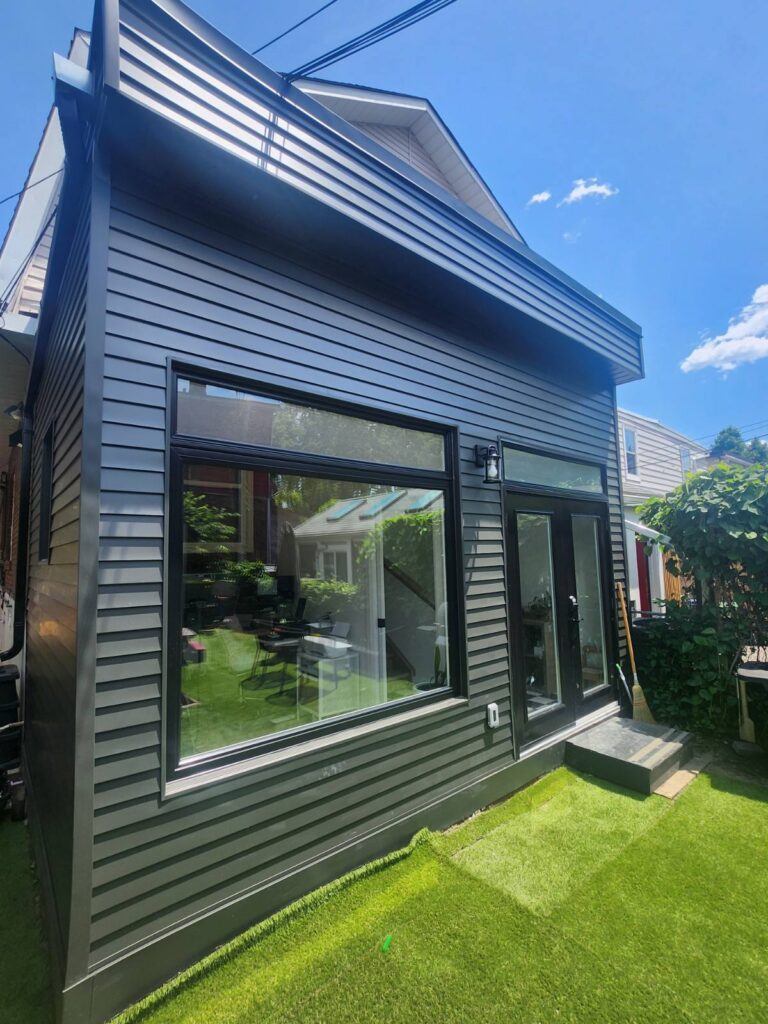
Many older Toronto homes were built decades ago, when families needed less space. Today, homeowners often need extra room for a home office, a growing family, or rental income. A Home Addition Toronto project can add valuable square footage through a finished basement, a garage conversion, a rear addition, a second-storey addition, or a garden or laneway suite.
Key Takeaways
- East York’s pre-war and interwar housing stock averages 900–1,400 sq ft of finished living space.
- Five realistic ways to add space to an older Toronto home: finished basement, garage conversion, rear bump-out, second-storey (top-up) addition, and a laneway or garden suite.
- Toronto home addition costs typically run $365 to $550 per square foot, depending on complexity, finishes, and structural work.
- The right option depends on lot geometry, foundation condition, and what you actually need the space for as opposed to which option sounds easiest.
Confronting Space Problems in Older Toronto Homes
Older Toronto homes seem to feel like they run out of space quickly because the foundations of these homes were not designed for open-concept living. How to add extra square footage, therefore, does not have a simple answer. Housing stock in neighbourhoods like East York, Leslieville, the Danforth, or the Junction repeating: narrow lots, 1.5- or 2-storey homes from the 1920s through 1950s, and floor plans built around small bedrooms and a single bathroom.
These homes were designed for households of four sharing 1,000 square feet. They were not designed for a couple working from home, two kids needing separate bedrooms, an in-law suite, and a primary ensuite. The mismatch is the single most common reason owners of older Toronto homes start asking what an addition would cost.
In our experience, there are five realistic options to “add space”, each with a different cost profile, disruption level, and suitability to specific lot and house conditions. The wrong choice can cost a homeowner $200,000 with little resale benefit; the right one can add functional square footage at a defensible per-square-foot rate.
The Six Realistic Ways to Add Square Footage
1. Finished Basement
The lowest-cost option and the first one most homeowners should evaluate. A finished basement in an older home is rarely a simple drywall job — most pre-war foundations in East York were rubble or unreinforced concrete, with ceiling heights under 7 feet and chronic moisture issues. Underpinning to gain headroom adds significant cost.
- Typical cost range: $80–$180 per square foot finished; underpinning can add $400–$700 per linear foot of foundation.
- Disruption: Moderate. The main living floors remain usable during most of the work.
- Best suited to: Homes with dry foundations and at least 6’6″ of existing headroom. Households needing a rec room, guest suite, or rental unit.
- What it does not do: Add to your home’s above-grade square footage as recorded by MPAC, which limits its resale impact.
2. Garage Conversion
Converting an attached or detached garage into living space looks cheap on paper and often isn’t. Most older Toronto garages were built on shallow slabs without insulation, frost-protected foundations, or plumbing rough-ins. Converting one to a year-round bedroom or office means rebuilding the floor assembly, upgrading the envelope to current code, and routing services.
- Typical cost range: $200–$350 per square foot for a code-compliant year-round conversion.
- Disruption: Low to moderate. The main house is largely unaffected.
- Best suited to: Homeowners with an attached garage they no longer need for vehicles, or detached garages already used as workshops.
- Trade-off: You lose covered parking permanently, which matters in neighbourhoods with permit-only street parking.
3. Rear Bump-Out Addition
A rear bump-out extends the ground floor — and sometimes the second floor — into the backyard. For East York lots with usable rear yard depth, this is often the most cost-effective way to add real, above-grade square footage to a kitchen or family room.
- Typical cost range: $365–$480 per square foot, depending on whether mechanical, structural, and roof tie-ins are simple or complex.
- Disruption: Moderate. The household can often remain in place during much of the build, since work happens beside, not on top of, existing living space.
- Best suited to: Lots with sufficient rear yard to maintain required setbacks (typically 7.5 m) and lot coverage limits (35–50 percent). Owners who want to fix a cramped kitchen or add a family room without losing the upstairs layout.
4. Second-Storey (Top-Up) Addition
The most transformative option, and usually the most expensive. A top-up addition removes the existing roof, builds one or two new floors of structure, and re-roofs. The result is essentially a doubled house on the same footprint, which is why it dominates East York’s recent renovation activity.
- Typical cost range: $400–$550+ per square foot, finished. Foundation and structural reinforcement to support the new load can add $30,000–$80,000 before any framing begins.
- Disruption: High. Most households must move out for 4–8 months.
- Best suited to: Bungalows and 1.5-storey homes where the lot has no usable rear yard, or where the goal is to add multiple bedrooms and a primary suite without losing backyard space.
- Critical caveat: Not every existing foundation can carry a second storey. A structural engineer’s assessment must happen before design fees are committed.
5. Laneway Suite or Garden Suite
These are detached secondary dwelling units in the rear yard, governed by distinct City of Toronto bylaws. They are not the same thing, and the distinction matters for East York homeowners. A laneway suite requires the lot to border a public laneway of at least 3.5 m in width. Most East York streets are not served by laneways, so this option is unavailable to the majority of homeowners in the neighbourhood. A garden suite can be built on most eligible residential lots without laneway access, with the unit accessed from the street through a side yard.
- Typical cost range: $400–$600 per square foot, with garden suites trending lower and laneway suites higher due to servicing complexity.
- Disruption: Low to the main house. The main residence remains fully functional throughout construction.
- Best suited to: Owners with rear yard depth who want a self-contained rental unit, multi-generational living arrangement, or income-producing asset.
- Limitation: Toronto permits only one accessory dwelling unit per lot — either a garden suite or a laneway suite, never both.
6. Utility Outbuilding
If you need space fast and would rather skip municipal red tape, there is a highly effective strategy in Toronto’s building regulations. You can construct a detached utility outbuilding, technically categorized as a “shed”, of up to 15 square metres (approximately 161 square feet) without needing a building permit. To qualify for this exemption, the structure must be a single storey, have no plumbing, and cannot be used to park a vehicle. Bypassing the permit process saves months of delays and thousands of dollars in architectural and application fees. While its legal use is restricted to ancillary storage, a well-built, weather-tight outbuilding is a fantastic way to move workshops, bulky gear, or seasonal items out of the house, instantly freeing up premium square footage indoors.
- Typical cost range: $80–$250 per square foot, depending on the quality of materials, insulation, and electrical work (note: adding power still requires a separate Electrical Safety Authority permit).
- Disruption: Very low. The build happens entirely in your backyard, usually completed in a matter of days or weeks with zero impact on your main living space.
- Best suited to: Homeowners who need immediate, budget-friendly overflow space for hobbies, tools, or storage, and want to completely avoid the headache of city approvals.
- Key limitation: While exempt from a building permit, the structure cannot be used as a habitable dwelling, office, or rental. You must also still strictly adhere to Toronto’s zoning bylaws regarding property line setbacks and maximum lot coverage.
| Option | Typical Cost Range | Disruption Level | Best Suited For | Key Limitation |
| Finished Basement | $80–$180/sq ft (underpinning adds $400–$700/linear ft) | Moderate | Dry foundations; adding rec rooms, guest suites, or rentals | Does not add above-grade square footage, limiting resale impact |
| Garage Conversion | $200–$350/sq ft | Low to moderate | Underutilized attached garages or existing workshops | Permanent loss of covered parking |
| Rear Bump-Out | $365–$480/sq ft | Moderate | Deep lots; expanding ground-floor kitchens or family rooms | Constrained by strict rear setback and lot coverage limits |
| Second-Storey (Top-Up) | $400–$550+/sq ft (structural reinforcement adds $30k–$80k) | High (requires moving out for 4–8 months) | Bungalows needing multiple bedrooms without losing backyard space | Existing foundation may lack the capacity to carry the new structural load |
| Laneway / Garden Suite | $400–$600/sq ft | Low | Multi-generational living or standalone income properties | Strictly limited to one accessory dwelling unit per lot |
| Utility Outbuilding | $80–$250/sq ft | Very low | Fast, budget-friendly overflow space for storage or workshops | Strictly non-habitable (no plumbing); must still follow zoning setbacks and lot coverage rules |
How to Choose: Disruption, Cost, and Lot Fit
Navigating Toronto’s complex zoning bylaws and century-old structural quirks requires more than just a blueprint; it requires a strategic partnership. As a premium general contractor, D2 Build takes the guesswork out of your renovation by actively guiding you through a proven, transparent decision tree. We help you balance family disruption, overall costs, and your specific lot constraints to find the absolute best expansion strategy for your home.
Here is how we evaluate your property’s unique potential:
- Is the basement dry and tall enough? We often look here first. Underpinning, benching, or simply finishing an existing basement provides the most cost-effective premium square footage you can invest in. Our team handles the crucial foundational integrity and moisture mitigation required to transform damp, low-ceiling cellars into flawless living spaces.
- Do you have a usable rear yard with at least 4–5 meters of depth to spare after setbacks? If so, a seamless rear bump-out or a custom garden suite becomes highly viable. We manage the delicate balance between adding functional indoor square footage and preserving your outdoor oasis, expertly handling all local zoning compliance and permit approvals.
- Is your lot small, depth-restricted, or already at maximum site coverage? Building up is frequently the smartest remaining path. However, before you fall in love with an architectural concept, D2 Build coordinates with top-tier structural engineers to evaluate your older home’s load-bearing capacity. This ensures a second-story addition is structurally sound, safe, and beautifully integrated with the original architecture.
- Is your property adjacent to a public laneway? Only then is a highly sought-after laneway suite on the table. We navigate the city’s strict logistical requirements—from emergency service access routes to complex trenching for utility connections—to design and construct a suite that maximizes your property’s long-term value and utility.
The space problem in older Toronto homes is real, but a Home Addition Toronto project is not a single product—it is a match between five distinct construction approaches and the specific constraints of a given lot, foundation, and household.
Why Homeowners Choose D2 Build
- 30+ years of experience renovating older Toronto homes
- Licensed design-build team
- Expertise in home additions, garage conversions, garden suites, and laneway suites
- Deep knowledge of Toronto permits, zoning bylaws, and building code requirements
- Serving East York, Leslieville, Riverdale, Danforth, and surrounding neighbourhoods
For a property-specific feasibility review of additions in East York and surrounding neighbourhoods, contact D2 Build for a consultation.
Frequently Asked Questions
How much does it cost to add 500 square feet to a house in Toronto?
A 500 sq ft addition in Toronto typically costs between $182,500 and $275,000 at current market rates of $365 to $550 per square foot. Rear bump-outs trend toward the lower end of that range; second-storey additions and additions with new foundations sit at the higher end. Permits, architectural drawings, and structural engineering are usually included in reputable contractor estimates.
Is it cheaper to add a second storey or build out?
Building out (a rear or side bump-out) is usually cheaper per square foot than building up, because second-storey additions require removing the existing roof, reinforcing the foundation, and temporarily exposing the home to weather. However, building out consumes yard space and is constrained by lot coverage bylaws, so the right answer depends on lot geometry rather than cost alone.
Can you add a second storey to any Toronto bungalow?
No. Adding a second storey requires the existing foundation and load-bearing structure to either carry the new load or be reinforced to do so. A structural engineer must assess the foundation, footings, and framing before design proceeds. Some 1920s and 1930s East York bungalows have foundations that require significant underpinning before a top-up addition is feasible.
Do I need a permit for a finished basement in Toronto?
Yes. A finished basement that adds a bedroom, bathroom, or secondary suite requires a building permit from the City of Toronto. Permits ensure compliance with current Building Code requirements for egress windows, ceiling height, fire separation, and electrical work. Skipping the permit creates problems at resale, with insurance, and with any future renovation that requires reconciling unpermitted work.
What is the difference between a garden suite and a laneway suite?
A laneway suite is a detached secondary dwelling unit on a lot that abuts a public laneway, with vehicle access from the lane. A garden suite is a detached secondary dwelling unit on a lot without laneway access, with pedestrian access through a side yard. Garden suites became legal across Toronto in July 2022, expanding eligibility to thousands of additional properties. Toronto allows only one of the two per lot.
How long does a home addition take in Toronto?
A finished basement typically takes 2–4 months. A rear bump-out runs 4–7 months from permit to completion. A second-storey addition usually takes 6–10 months, with the household relocated for most of the build. Garden and laneway suites take 6–9 months on average. Permit approval timelines are separate and can add 2–6 months before construction begins.
Is a Home Addition Toronto project worth the investment?
Most well-executed additions in established Toronto neighbourhoods recover 60–80 percent of project cost at resale, with kitchen and primary suite additions trending highest. Garden and laneway suites add income-based value when rented but have limited resale comparables. Finished basements add value but less than above-grade square footage, since MPAC and most appraisers weigh above-grade space more heavily.
Can I live in my house during a Toronto home addition?
For finished basements, garage conversions, rear bump-outs, and detached suites, most households remain in the home throughout. Second-storey additions almost always require temporary relocation for 4–8 months because the roof is removed and the interior is exposed to weather. Project scope, season, and household composition all affect whether staying in place is realistic.

